Working Memory refers to the brain's mental Random Access Memory (RAM) system that holds information temporarily in mind while simultaneously editing, manipulating, and computing that information. It is the fundamental infrastructure for all intellectual activities including daily reading, mental arithmetic, reasoning, and complex puzzle-solving. Psychometrically, it shares a very strong positive correlation (r = 0.6 to 0.8) with Fluid Intelligence (Gf).
1. The Four Components of Baddeley's Model
The most widely accepted definition of working memory is the "Multi-Component Model" proposed by Alan Baddeley and Graham Hitch in 1974. They clarified that working memory is not a single storage unit, but a highly interactive network consisting of the following four components:
- Central Executive: The command center of working memory. It determines how limited "attentional resources" are allocated, filters out unnecessary noise (cognitive inhibition), and controls task switching.
- Phonological Loop: A subsystem that temporarily holds verbal information in auditory form. It functions as the "inner tape recorder," activating when you repeat a phone number in your head (articulatory rehearsal).
- Visuospatial Sketchpad: A subsystem that temporarily holds visual imagery and spatial layouts. It acts as the "inner canvas," activating when you draw a map or rotate a 3D object in your mind (mental rotation).
- Episodic Buffer: A multi-dimensional buffer system that integrates phonological and visuospatial information with chronological and contextual framing, binding them into coherent episodes in cooperation with long-term memory.
2. Capacity Limitations: The Mathematical Reality of "Magical Number 4"
The most prominent feature of working memory is its extremely limited capacity. Psychologist George Miller originally proposed that the number of items short-term memory can hold is "7±2" (the Magical Number 7). However, subsequent cognitive experiments strictly eliminating subvocal rehearsal revealed that the pure capacity of working memory is actually only about "4±1" (3 to 5 items) (Cowan's Magical Number 4).
This tiny "mental scratchpad" acts as the bottleneck of logical reasoning. For example, when solving a complex rules puzzle, if the number of variables to process at once (e.g., shape movements, color inversions, size variations) exceeds 4, working memory overflows, causing the brain to freeze.
3. Neurobiological Mechanism: DLPFC and Parietal Cooperation
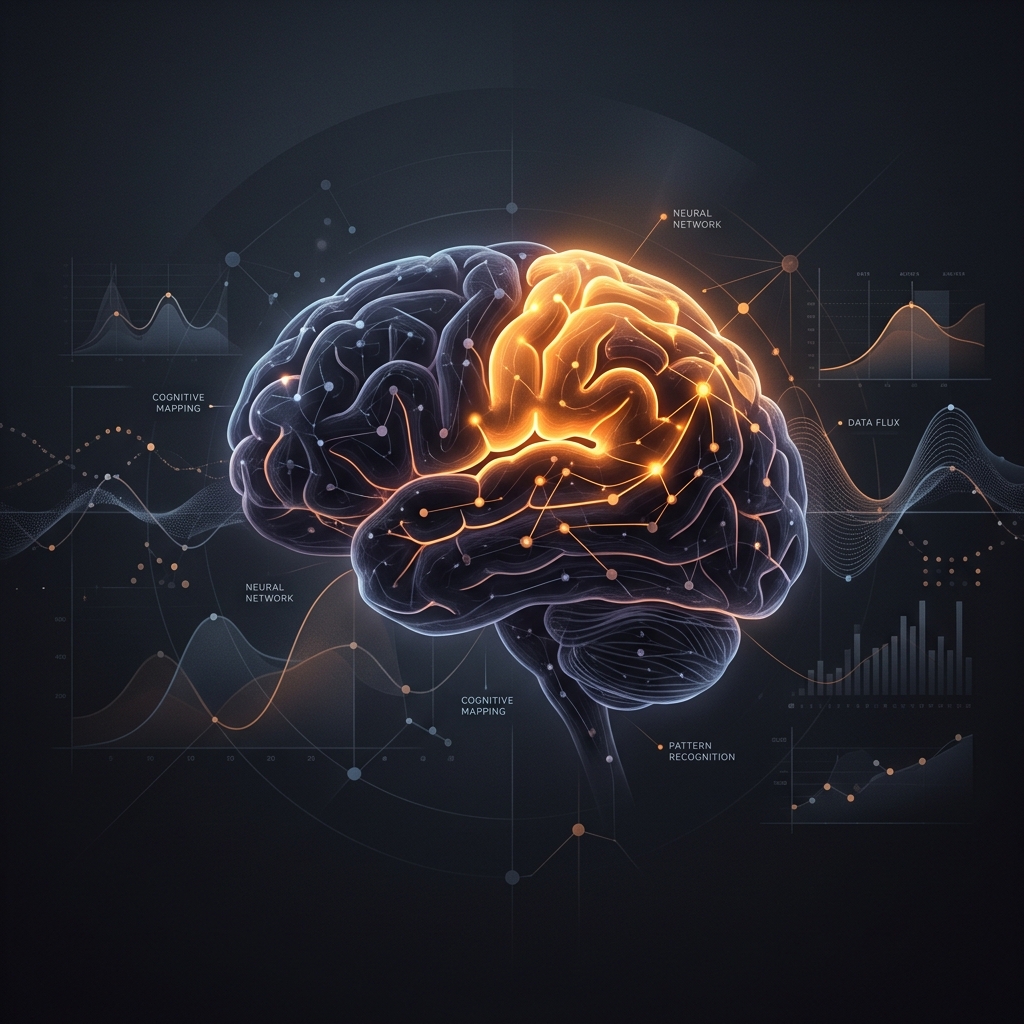
Functional brain imaging (fMRI) studies show that the central executive function of working memory is primarily localized in the Dorsolateral Prefrontal Cortex (DLPFC). The DLPFC serves as a neural filter to lock attention onto specific goals and block out distracting stimuli.
Furthermore, during visuospatial operations, the DLPFC and the Parietal Lobe visually co-fire to render the imagery. The physical connectivity of this neural network (characterized by low resistance due to myelinated white matter tracts) represents the physiological basis of high working memory capacity and high IQ scores.
4. Conclusion: Attentional Infrastructure of Intelligence
In intelligence testing (especially WAIS-IV clinical examinations), the Working Memory Index (WMI) is one of the four main pillars used to compute Full Scale IQ (FSIQ). A robust working memory leads to high learning efficiency and allows individuals to make clear, logical decisions under stress without experiencing "digital brain fog."