
Neuroscience / Scientific Article
The Multitasking Illusion: How Task-Switching Toll Destroys Cognitive Processing Speed
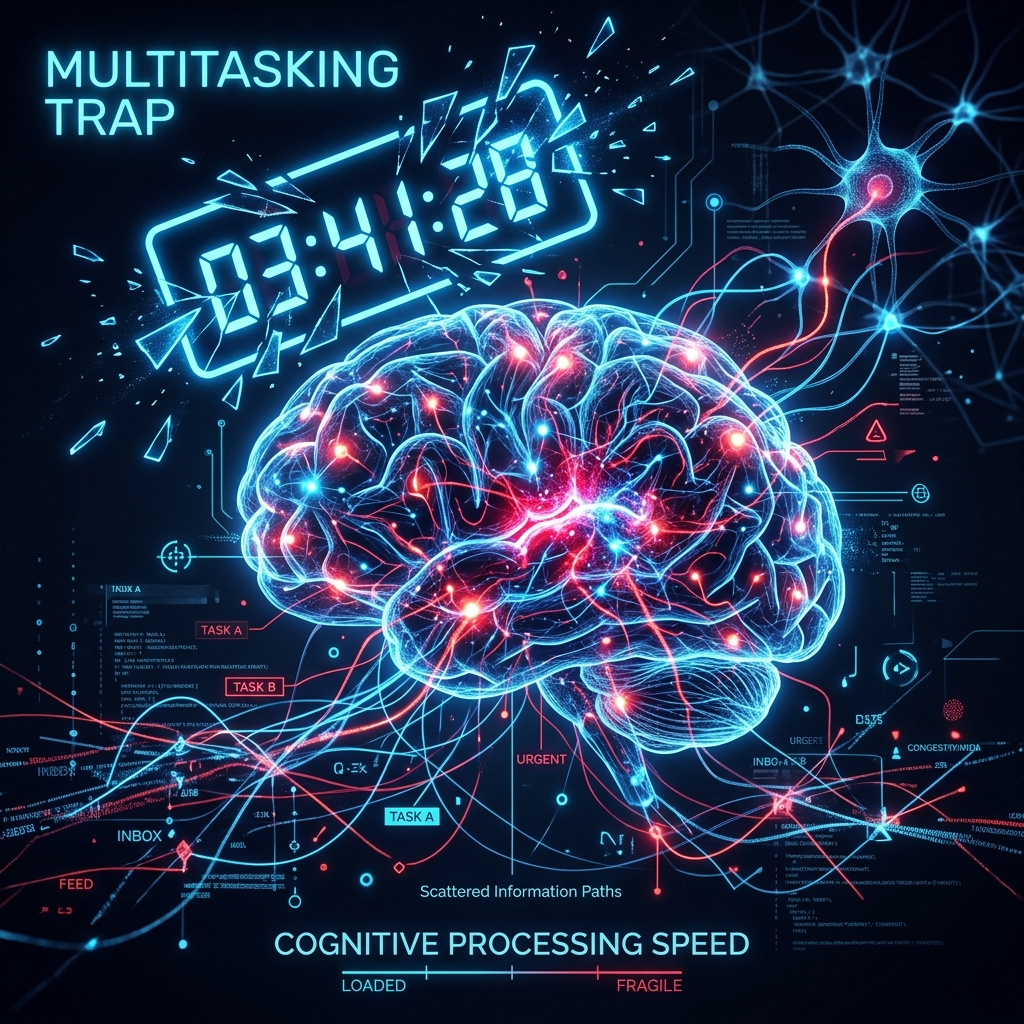
The modern belief that we can process multiple tasks simultaneously is a dangerous cognitive myth. Neuroscience confirms that multitasking is actually rapid, exhausting task-switching that depletes executive resources, clogs working memory slots, and cripples your cognitive Processing Speed.
Drafting a report, responding to instant messages, and listening to an academic podcast—in our hyper-connected, high-speed era, we praise multitasking as the gold standard of productivity. Yet, cognitive psychology presents a cold, biological truth: the human brain is structurally incapable of concurrent conscious processing. Multitasking is a neurological illusion. In reality, it is a high-latency process of "rapid task-switching" that inflicts a massive switching toll, exhausting your prefrontal cortex and temporarily lowering your functional IQ.
1. The Myth of Parallel Processing: Understanding Task-Switching
Unlike a multi-core computer CPU, the conscious executive network of the human brain operates on a single-channel bottleneck. When you attempt to multitask, your brain is not running processes side-by-side. Instead, your prefrontal cortex is frantically shifting its attentional focus back and forth: from Task A to Task B, then back to Task A.
Every time this switch occurs, a cognitive "switching cost" is levied:
- Attentional Residue: When shifting focus, a portion of your cognitive resources remains stuck processing the previous task. It takes time for the brain to clear this residue.
- Glucose Depletion: Shifting focus requires massive energy. Rapid switching quickly burns through the prefrontal cortex's fuel supply (glucose and oxygen), resulting in cognitive fatigue and digital brain fog.
2. Saturated Working Memory and Delayed Processing Speed
Every task-switch inflicts heavy damage on your Working Memory capacity. According to cognitive models like Nelson Cowan's, our active working memory can only hold about "4±1 chunks" of information at once.
When you multitask, your 4 precious slots are instantly clogged:
- Slot 1 & 2: Holding the unfinished syntax and goals of Task A.
- Slot 3: Tracking the incoming notification from Task B.
- Slot 4: Storing distracting auditory stimuli from your background environment.
With your mental workspace completely saturated, you have zero RAM left to perform active logical reasoning or spot complex rules. Consequently, your neural Processing Speed plummets. You experience an average 40% drop in productivity, and your error rate climbs exponentially. Clinical trials at the University of London demonstrated that media multitasking can temporarily cause a 15-point drop in functional IQ—equivalent to the cognitive decline of pulling an all-nighter.
3. Structural Damage: The Shrinking Prefrontal Cortex
The threat of multitasking extends beyond daily fatigue; it physically alters the structural anatomy of your brain. In a pioneering study utilizing structural MRI scans, neuroscientists evaluated individuals who reported high levels of daily media multitasking (e.g., browsing the web while watching television).
The results were shocking: heavy multitaskers showed reduced gray matter density in the anterior cingulate cortex (ACC). The ACC is the precise region responsible for cognitive control, emotional regulation, and attentional focus. By repeatedly forcing the brain to switch tasks, Neuroplasticity works in reverse, pruning away the vital structural connections that allow for deep, sustained intellectual focus.
4. Reclaiming Focus: The Power of Single-Tasking
The most powerful cognitive biohack in our digital age is the strict practice of single-tasking. By muting notifications, closing extra browser tabs, and dedicating your entire Working Memory exclusively to one logical flow, you liberate your Processing Speed.
When taking an intelligence test on "IQ Lab", remember to treat the experience as a "single-task sanctuary." Turn off your phone, sit in a quiet room, and commit your entire frontoparietal network to the visual matrices. This deliberate focus training allows your executive networks to re-myelinate, restoring your baseline Processing Speed and general cognitive power.
Cognitive Science Q&A (FAQs)
Q.Is listening to music while studying considered multitasking?
Yes, if the music contains lyrics. Vocal tracks force the language-processing centers of your brain (the phonological loop in working memory) to actively decode words, competing directly with the text you are reading. However, listening to lyric-free ambient music, classical compositions, or white noise can actually enhance focus by stimulating dopamine release and masking distracting environmental sounds.
Q.Are some people naturally good at multitasking?
Neuroscientific studies consistently show that individuals who self-identify as "excellent multitaskers" are actually the worst performers in task-switching experiments. They are easily distracted by irrelevant stimuli and struggle to filter out noise. The feeling of being "good at multitasking" is a dopamine-driven illusion of busywork; the brain is simply addicted to the novel hits of adrenaline triggered by switching tasks.
Academic References (Citations)
- Ophir, E., Nass, C., & Wagner, A. D. (2009). Cognitive control in media multitaskers. PNAS, 106(37), 15583-15587.
- Loh, K. K., & Kanai, R. (2014). Higher media multi-tasking activity is associated with smaller gray-matter density in the anterior cingulate cortex. PLOS ONE, 9(9), e106698.
Cognitive Diagnostic Engine
Ready to measure your cognitive balance scientifically?
IQ Lab evaluates your skills across 5 core cognitive domains from a randomized 300-question pool, generating high-precision profiles and personal diplomas completely free.