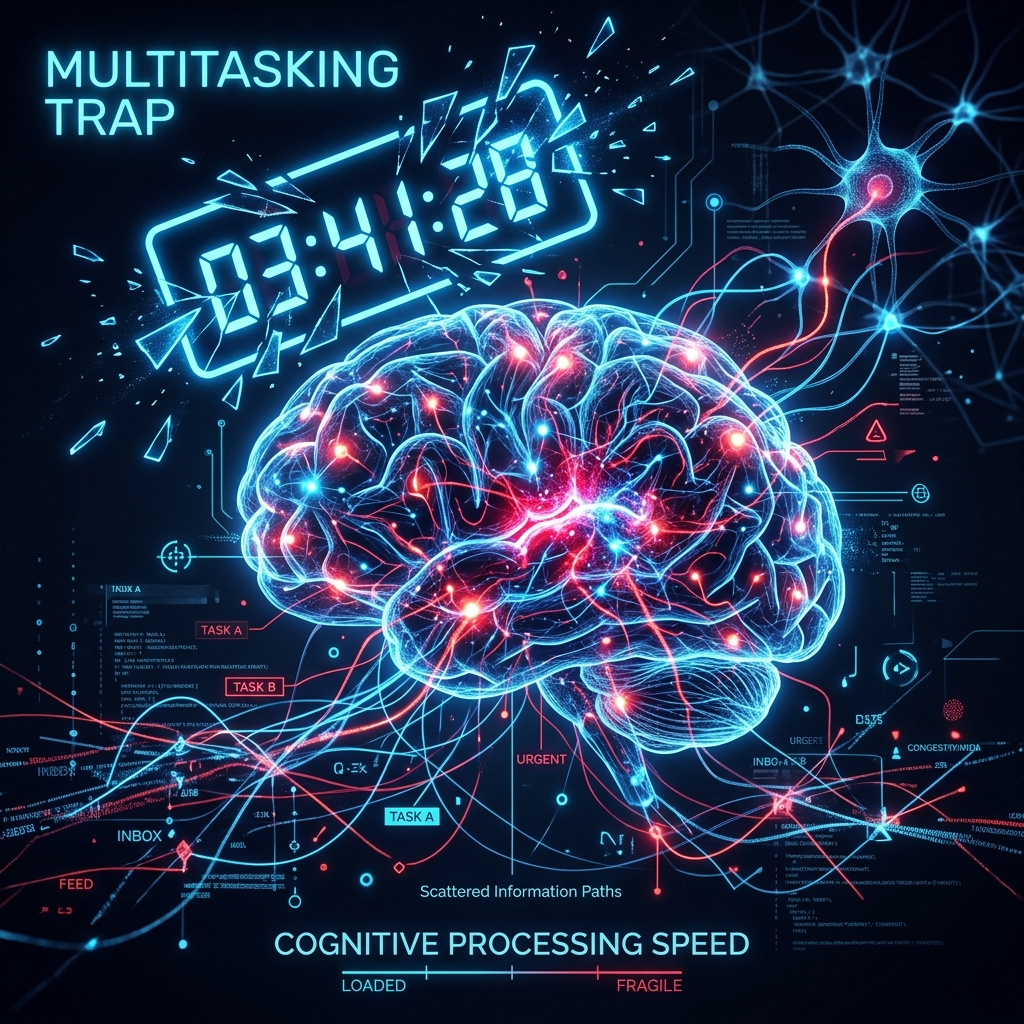

Processing Speed represents the rate at which the central nervous system can visually identify, sort, and execute simple, automatic, and repetitive mental tasks. Measured as the Processing Speed Index (PSI) in clinical WAIS-IV testing, it represents the biological clock rate of neural transmissions.
1. The Neurological Foundation: White Matter Myelination
Physiologically, processing speed is determined by the insulation of neural pathways—specifically, myelination of white matter tracts. Myelin serves as an electrical insulator surrounding axons, allowing electrical signals to jump rapidly down the line (saltatory conduction). A highly myelinated brain experiences extremely low resistance, allowing visual and logical signals to reach processing units with minimal latency.
2. Bottleneck of Complex Intelligence
While processing speed is tested through simple clerical matching tasks, it serves as a critical gatekeeper for higher reasoning. If processing speed is slow, simple variables (like shapes or digits) take too long to resolve. By the time the brain discovers the second or third rule of a puzzle, the first rule held in working memory decays, causing cognitive overload. Thus, high speed preserves valuable working memory space.
3. Age Changes and Peak
Biological processing speed peaks in the late teens and early 20s. Because myelin naturally thins with biological aging, visual processing speed undergoes a steady decline starting in the late 20s. However, this is largely mitigated by using crystallized shortcuts (heuristics) derived from experience.