
Cognitive Profiles / Scientific Article
The Beautiful Imbalance of High IQ: Understanding Asynchronous Development and Overexcitabilities in Gifted Minds
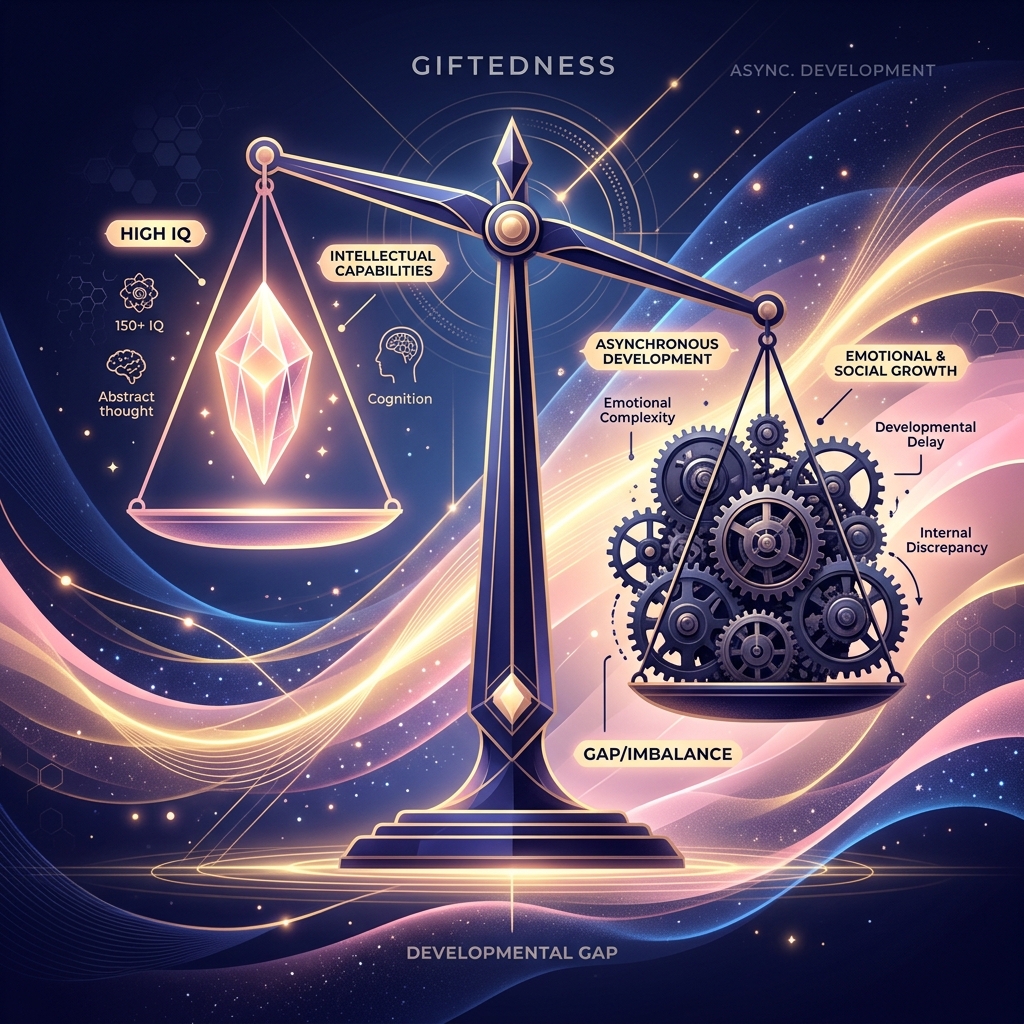
A high IQ profile (typically FSIQ > 130) is not merely a faster analytical engine; it is a qualitatively different nervous system. We analyze "Asynchronous Development" (the developmental gap between intellect, physical maturity, and emotions) and Kazimierz Dabrowski's five "Overexcitabilities" (OEs) that define the gifted experience.
When we think of a "gifted" individual (typically defined as scoring in the top 2.28% of the population, or an IQ of 130+ on standard psychometric scales), we often envision a perfect, balanced genius who excels effortlessly in every domain. Yet, developmental psychology reveals a far more complex reality. The core of Giftedness is not balance, but a beautiful, intense imbalance. This article explores the twin psychological pillars of the gifted mind: "Asynchronous Development" and "Overexcitabilities."
1. The Architecture of Asynchronous Development
Coined by the Columbus Group in 1991, the term Asynchronous Development describes the uneven rate of cognitive, physical, and emotional growth in highly intelligent individuals. In a gifted child, this desynchronization creates a profound internal disconnect:
- Intellectual Development (Rapid): The mind of an 8-year-old child may possess the conceptual capacity of a 16-year-old, easily digesting abstract scientific theories or geopolitical concepts.
- Physical Development (Average): Their fine motor skills and physical coordination remain strictly at their biological age of 8. The brain's vivid mental creations cannot be physically drawn or written, causing immense frustration.
- Emotional Development (Intense): Lacking social experience, their emotional coping mechanisms may lag, leaving them highly vulnerable to anxiety when confronted with complex existential concepts (like death, war, or infinity) that they can comprehend intellectually but cannot process emotionally.
To exist as a gifted individual is to experience life with multiple, conflicting ages residing inside a single mind.
2. Kazimierz Dabrowski's Five Overexcitabilities (OEs)
The physiological engine of Giftedness is a highly sensitive nervous system. Polish psychiatrist Kazimierz Dabrowski observed that gifted individuals process sensory, conceptual, and emotional data through a powerful psychological amplifier. He termed this heightened responsiveness Overexcitabilities (OEs) and categorized them into five specific domains:
- Intellectual OE: An insatiable hunger for truth, deep conceptual questioning, and persistent problem-solving. These individuals feel a compulsive urge to drive their Working Memory capacity to the limit to extract logical rules from their environment.
- Imaginational OE: Vivid visualization, elaborate dreams, creative metaphor design, and active fantasy play.
- Emotional OE: Deeply felt empathy, intense emotional responses, and extreme sensitivity to interpersonal dynamics or environmental stress.
- Sensory OE: An amplified sensory nervous system. Subtle clothing tags feel like sandpaper, and the low-frequency hum of a fluorescent bulb (which degrades visual Processing Speed) can trigger neurological overload.
- Psychomotor OE: Abundant physical energy, rapid speech, and a constant urge to move, which is frequently misdiagnosed as ADHD.
3. The Twice-Exceptional (2E) Profile
This developmental asymmetry often manifests in clinical settings as a Twice-Exceptional (2E) profile. A 2E individual possesses exceptional intellectual gifts alongside a specific cognitive bottleneck, such as ADHD, dyslexia, or ASD.
In a standard WAIS-IV examination, a 2E profile presents a highly jagged graph. The subject might score in the 99.9th percentile on Matrix Reasoning and Verbal Comprehension, but drop to the 40th percentile on Processing Speed. This massive variance causes them to struggle with simple, repetitive clerical tasks while excelling at high-level abstract conceptualization, often leading teachers and employers to falsely accuse them of laziness.
4. Harnessing the High-IQ Spectrum
Asynchronous development and overexcitabilities are not pathologies to be cured; they are the natural biological hallmarks of cognitive diversity. Understanding the structural map of your cognitive strengths and weaknesses is the crucial first step to thriving with a high-g profile.
The comprehensive cognitive evaluation at "IQ Lab" is explicitly designed to identify these unique profiles. By breaking down your performance across 5 distinct domains (Logical, Pattern, Spatial, Memory, and Speed), we help you visualize the shape of your intellectual blueprint, highlighting both your brilliant conceptual peaks and your infrastructure needs.
Cognitive Science Q&A (FAQs)
Q.What is the difference between being highly smart and being gifted?
High smartness is typically characterized by a well-balanced, highly efficient adaptation to standard academic and career systems. Giftedness, however, represents a qualitatively different neural setup. It is characterized by intense, obsessive curiosity (Intellectual OE), sensory sensitivities, and asymmetric development (such as high abstract reasoning paired with low processing speed).
Q.How do you support a Twice-Exceptional (2E) adult?
The key is "strength-based development." Focus entirely on leveraging their exceptional logical or spatial abilities, while utilizing technology (like AI tools, voice-to-text, and task managers) to externalize and support their weaker processing speed and working memory areas.
Academic References (Citations)
- Silverman, L. K. (2002). Asynchronous development. In M. Neihart, et al. (Eds.), The Social and Emotional Development of Gifted Children. Prufrock Press.
- Dabrowski, K. (1972). Psychoneurosis Is Not An Illness. London: Gryf Publications.
Cognitive Diagnostic Engine
Ready to measure your cognitive balance scientifically?
IQ Lab evaluates your skills across 5 core cognitive domains from a randomized 300-question pool, generating high-precision profiles and personal diplomas completely free.