
Cognitive Psychology / Scientific Article
The Illusion of Competence: Why the Unskilled Deem Themselves Skilled and the High-IQ Underestimate Their Mind
Metacognition represents the supreme intellectual capacity to accurately monitor and evaluate one's own skills. We explore how a lack of cognitive benchmark leads to the Dunning-Kruger Effect, where the unskilled overestimate their abilities and the highly gifted underestimate themselves.
In business, academia, and everyday life, we often witness a peculiar cognitive paradox: those with the least expertise speak with absolute confidence, while true experts remain modest, doubting their own exceptional capabilities. This is not merely a personality trait or social etiquette; it is a fundamental cognitive bias hardwired into the human brain. This article examines the structural mechanics of the Dunning-Kruger Effect and deconstructs its neural engine: the supreme executive facility known as Metacognition.
1. Deconstructing the Dunning-Kruger Effect
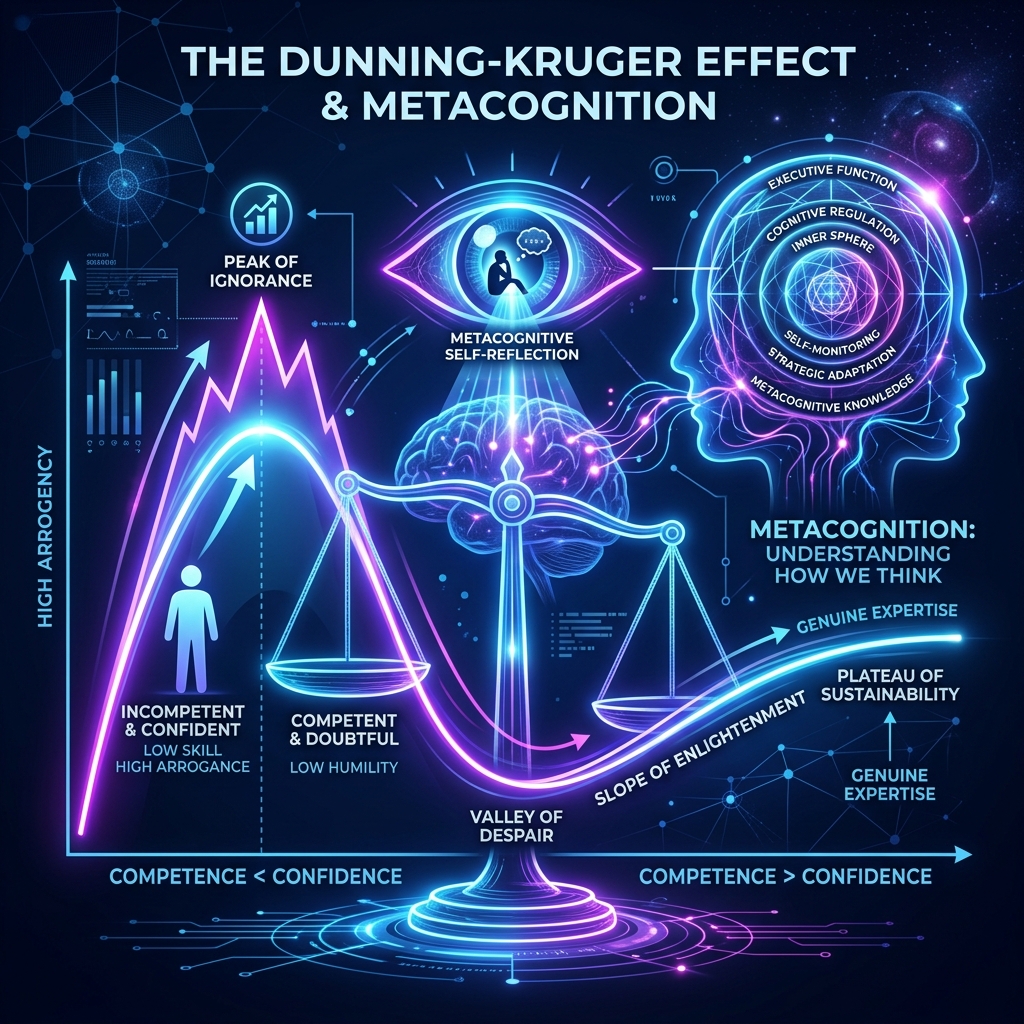
In 1999, social psychologists David Dunning and Justin Kruger conducted a series of landmark studies at Cornell University. Evaluating subjects across logical reasoning, grammar, and humor, they mapped actual test performance against the subjects' self-assessed ability. The resulting data revealed a stark, elegant curve: the lowest performers consistently and dramatically overestimated their competency, placing themselves in the 60th percentile when their actual scores sat in the bottom 12th.
This cognitive distortion—the Dunning-Kruger Effect—stems from a dual burden:
- Incompetence Deprives Self-Evaluation: The very deficits that cause an individual to make poor choices also prevent them from possessing the capacity to recognize what is "correct" or "optimal." Therefore, they remain blissfully unaware of their errors.
- Inability to Recognize True Talent: Lacking the cognitive benchmarks, unskilled individuals are structurally unable to gauge the excellence of high-quality solutions created by true experts, dismissing them as unnecessary or incorrect.
Conversely, high-performers (the top 25%) displayed the opposite bias: they routinely underestimated their relative standing. Because tasks like logical deduction felt simple to them, they operated under the false consensus effect, assuming that "if it is easy for me, it must be equally simple for everyone else."
2. Metacognition: The Command Center of the Mind
Why does this skew occur? The answer lies in a deficiency in Metacognition—literally, "cognition about cognition" or the capacity to stand outside oneself and monitor, evaluate, and regulate one's own thinking.
Metacognition is the brain's ultimate auditor. When solving a complex logical puzzle, it is your metacognitive network that alerts you: "This current logical pathway contains an unverified assumption," or "I need to double-check my working memory slots before committing to this pattern."
However, to deploy Metacognition, the brain requires structured knowledge schemas. If an individual lacks the baseline general intelligence or specific knowledge in a domain, their prefrontal networks have no baseline metrics to audit against. Lacking the tools to measure their own errors, they experience a false sense of absolute competence.
3. The Neurobiology of Self-Monitoring: Prefrontal Networks
Functional neuroimaging (fMRI) reveals that Metacognition is localized within the anterior prefrontal cortex (aPFC), specifically Brodmann Area 10 (BA10).
This anterior hub is structurally connected to sensory integration zones, memory systems, and attention networks. Individuals with high General Intelligence (g-factor) and exceptional executive control display thick gray matter volume and highly coordinated functional pathways linking BA10 with frontoparietal networks. This enables them to detect cognitive mismatch, audit their own performance in real-time, and adapt to novel variables. In contrast, a sluggish or unengaged prefrontal auditor leaves the individual trapped in static, uncalibrated self-assessments.
4. Overcoming the Bias: Cultivating "Intellectual Humility"
The only reliable antidote to the Dunning-Kruger Effect is the systematic training of your Metacognition. Admitting what you do not know—a principle going back to Socrates' "I know that I know nothing"—actively triggers the brain's Neuroplasticity. Once the brain acknowledges a processing gap, it begins building fresh synapses to map the missing variables.
Engaging with the logical diagnostic puzzles here on "IQ Lab" provides an objective, unvarnished mirror of your processing capabilities. When your confident assumptions are challenged by an incorrect answer, BA10 fires intensely, refining your Metacognition and tuning your brain's self-calibration for future analytical endeavors.
Cognitive Science Q&A (FAQs)
Q.Does the Dunning-Kruger Effect affect high-IQ individuals?
Yes, absolutely. While highly intelligent individuals are less likely to suffer from the effect in their primary fields of expertise, they are highly vulnerable when stepping outside their domain. A Nobel laureate in physics, for example, may confidently speak on economics or medicine, completely unaware that their lack of domain-specific benchmarks has triggered the Dunning-Kruger Effect.
Q.Can you train metacognitive ability?
Yes. The most effective method is "cognitive modeling"—verbalizing your internal reasoning step-by-step as you solve puzzles. Continually asking yourself questions like, "What assumptions am I making?" or "Why did I choose this specific pattern?" forces the anterior prefrontal cortex into active monitoring mode, permanently sharpening your Metacognition.
Academic References (Citations)
- Kruger, J., & Dunning, D. (1999). Unskilled and unaware of it: How difficulties in recognizing one's own incompetence lead to inflated self-assessments. Journal of Personality and Social Psychology, 77(6), 1121-1134.
- Fleming, S. M., & Dolan, R. J. (2012). The multisensory representation of self: neuroimaging of metacognition. Trends in Cognitive Sciences, 16(1), 35-42.
Cognitive Diagnostic Engine
Ready to measure your cognitive balance scientifically?
IQ Lab evaluates your skills across 5 core cognitive domains from a randomized 300-question pool, generating high-precision profiles and personal diplomas completely free.