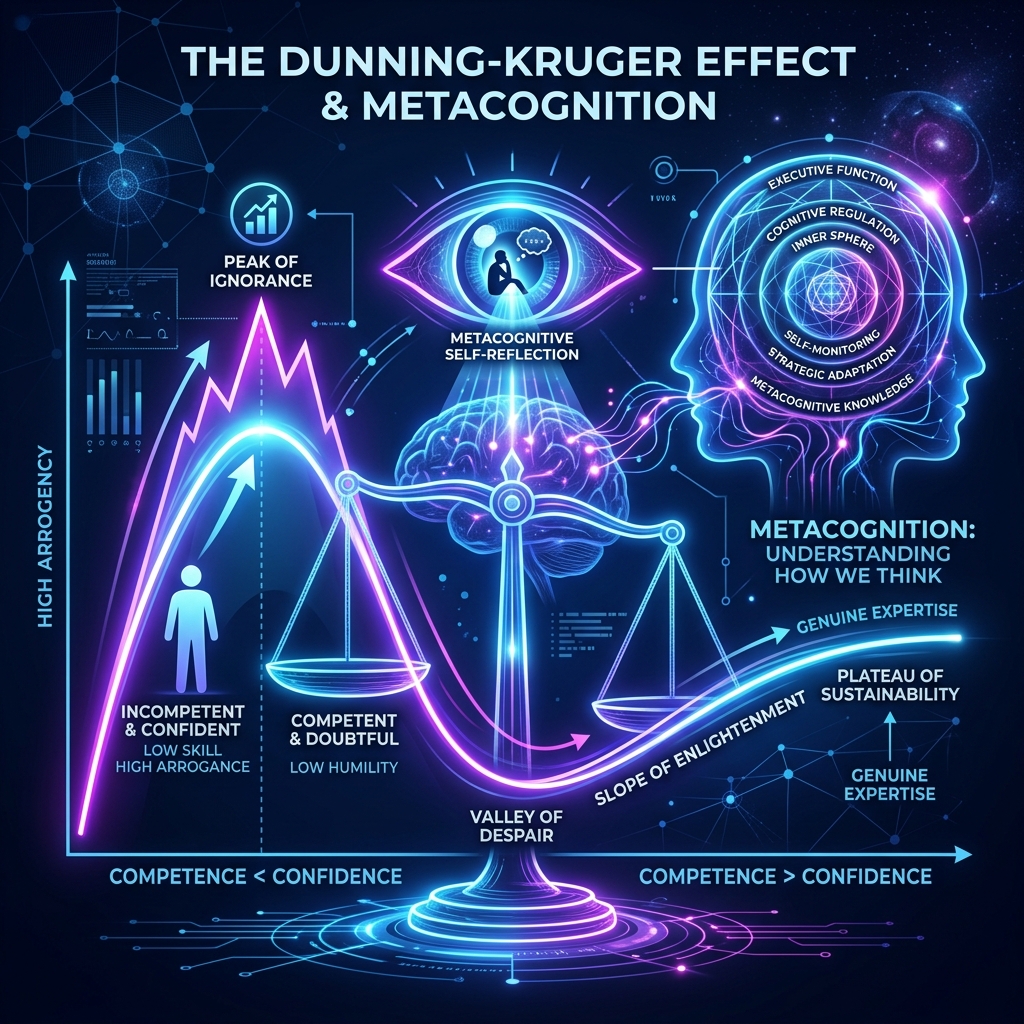
The Dunning-Kruger Effect is a cognitive bias where individuals with low ability in a particular domain overestimate their competence, while experts mistakenly assume that tasks easy for them are equally easy for others, leading to an underestimation of their relative standing. This represents a neurological bottleneck of metacognition (the ability to accurately evaluate one's own mental performance).
1. The Landmark Cornell Experiment
First mapped in 1999 by Cornell social psychologists David Dunning and Justin Kruger, they tested subjects in logic, grammar, and humor. The statistical data revealed a striking double burden:
- Overestimation at the Bottom: Subjects in the bottom 25% of actual test scores estimated their performance to be above the 60th percentile.
- Underestimation at the Top: High-performing subjects (top 25%) underestimated their percentile rank, assuming others found the test just as easy.
Dunning and Kruger concluded that the skills required to be competent in a field are identical to the skills needed to realize you are bad at it.
2. The Journey from "Mount Stupid" to "Plateau of Sustainability"
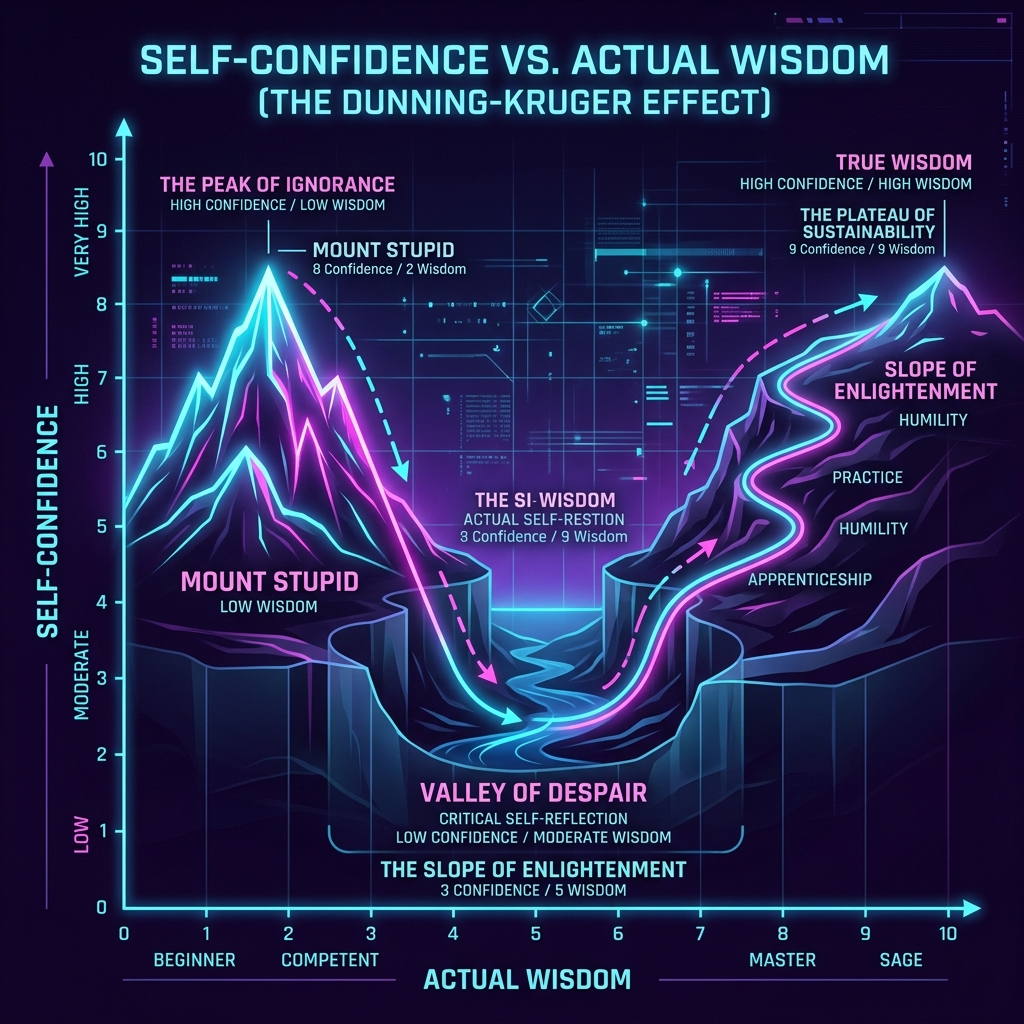
The effect is typically visualized as a developmental curve tracking confidence against wisdom:
| Developmental Stage | Self-Confidence Status | Cognitive Mechanism |
|---|---|---|
| 🐣 1. Mount Stupid | 100% Confidence (Max) | Acquired a tiny amount of introductory knowledge. Unaware of the vastness of the subject, leading to extreme, vocal overconfidence. |
| 😰 2. Valley of Despair | 0% Confidence (Min) | Gained experience and realized the immense depth of the domain. Metacognition starts working, leading to acute self-doubt. |
| 🧗 3. Slope of Enlightenment | Growing Confidence | Steadily building authentic skills and testing variables, forming balanced, evidence-backed confidence. |
| 🏆 4. Plateau of Sustainability | Balanced, Humbling Mastery | Expertise level. Possesses elite skills but remains humble, knowing there are always variables and margins for error. |
3. Why High-IQ Minds Fall into the "Valley of Despair"
High-g individuals naturally bypass "Mount Stupid" and plunge straight into the "Valley of Despair." Their fast relational reasoning allows them to see the extreme complexity of a domain immediately, making them highly sensitive to their own conceptual gaps (often triggering Imposter Syndrome).