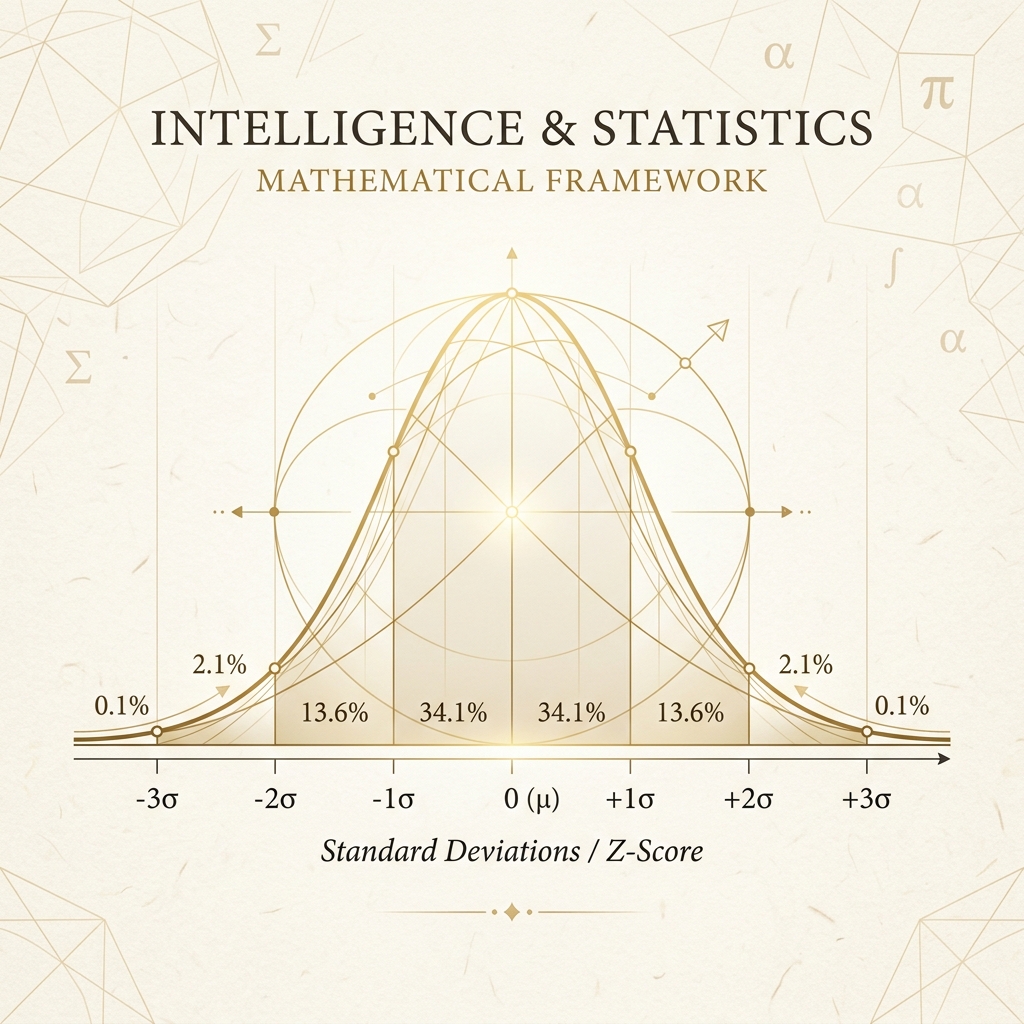

An Intelligence Quotient (IQ) score represents a relative standing compared to one's peer group. In clinical psychology, Full Scale IQ (FSIQ) is the gold-standard composite rating derived from Wechsler scale examinations (like the WAIS-IV), representing overall cognitive efficiency.
1. The Four Index Indices of FSIQ
FSIQ is not measured by a single puzzle test; it is mathematically computed from 10 core subtests across 4 cognitive domains:
- Verbal Comprehension Index (VCI): Vocabulary, abstract word relationships, and general database knowledge (Crystallized Gc).
- Perceptual Reasoning Index (PRI): Novel matrix reasoning, visual puzzle folding, and non-verbal reasoning (Fluid Gf).
- Working Memory Index (WMI): Auditory details holding and active numeric manipulation.
- Processing Speed Index (PSI): Rapid visual scanning and check rates.
2. Standard Deviation and Normalization
FSIQ scores are standardized to a population mean of 100 with a Standard Deviation of 15. An FSIQ score of 130 (+2 SD) represents the 97.7th percentile, the statistical marker for structural Giftedness.
3. Clinical Discrepancies (Jagged Cognitive Profiles)
FSIQ is a highly predictive metric for overall learning speed and complex system modeling. However, in developmental psychology, clinical analysts prioritize discrepancies (凹凸) between the 4 index scores over the FSIQ value. For instance, an individual might score an IQ 140 in PRI but drop to 90 in PSI. A simple average puts their FSIQ around 118, masking a massive 50-point processing lag. This imbalance is the primary indicator of Twice-Exceptional (2E) profiles, highlighting why detailed cognitive mappings are superior to flat numerical IQ claims.