
Psychometrics / Scientific Article
The Truth About Standard Deviation: Comparing SD15 and SD24 Scales
Is IQ 130 identical to IQ 148? We demystify standard deviation, percentile mapping, and Mensa qualification to prevent numeric confusion.
Internet debates like "My IQ is 148" versus "I scored 130 on the WAIS" are often completely empty. They represent the exact same level of intelligence measured on different standard deviation scales. This article demystifies the statistical scaling of IQ.
1. The Bell Curve and Percentiles
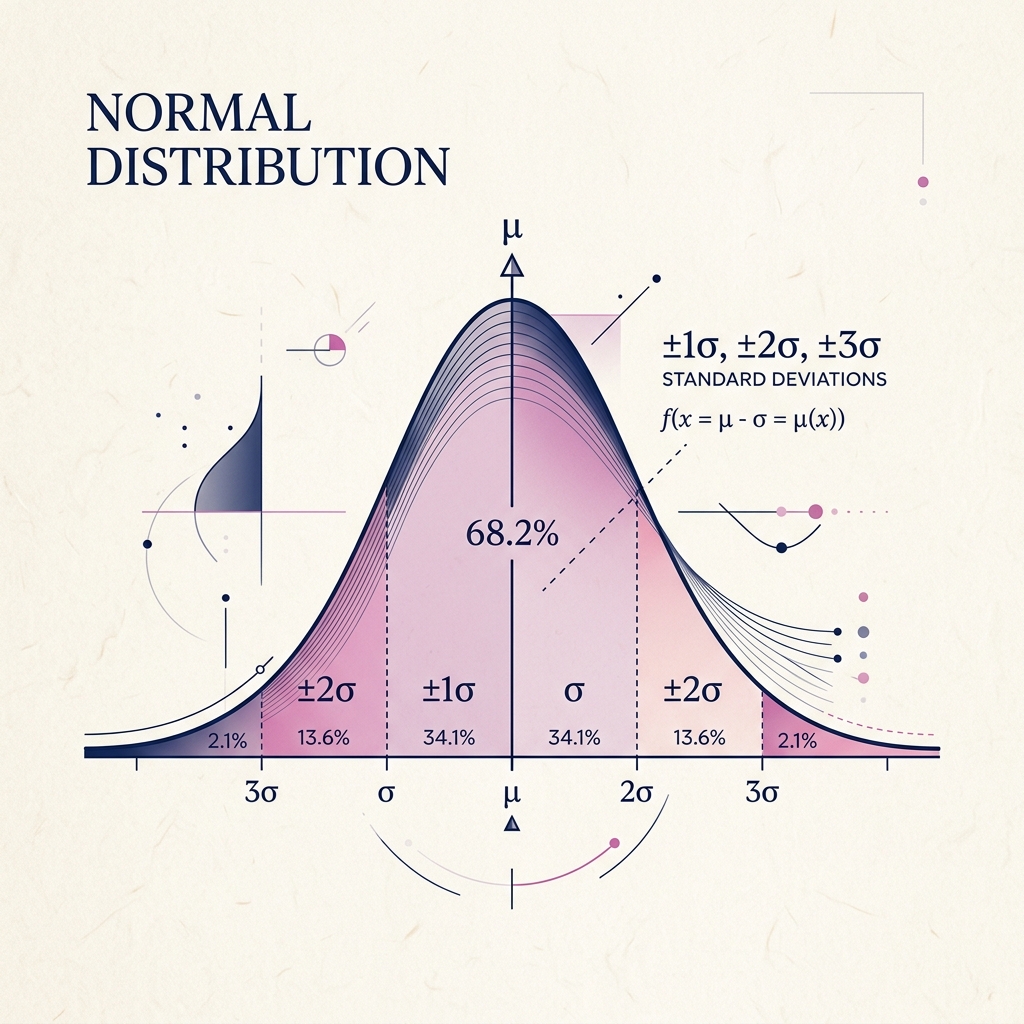
Modern intelligence tests use relative Deviation IQ, mapping scores to a standard Gaussian normal distribution where the population average is locked at 100. Standard Deviation (SD) dictates the width of the bell curve's divisions:
- SD 15 Scale (WAIS/Wechsler): The standard in clinical psychology. ±1 SD (85-115) houses 68.27% of the population. IQ 130 represents +2 SD (top 2.28% of the population).
- SD 24 Scale (Cattell): Used by historical scales and some MENSA branches. IQ 148 represents +2 SD (top 2.28% of the population).
2. Direct Conversion Chart
To prevent numeric confusion, here is the conversion table:
| Percentile Rank | Statistical Rarity | IQ Score [SD 15] | IQ Score [SD 24] |
|---|---|---|---|
| 50.0% (Average) | 1 in 2 people | IQ 100 | IQ 100 |
| 15.8% (+1 SD) | 1 in 6 people | IQ 115 | IQ 124 |
| 2.28% (Gifted Limit) | 1 in 44 people | IQ 130 | IQ 148 |
| 2.00% (MENSA Limit) | 1 in 50 people | IQ 131 | IQ 150 |
3. Mensa Qualifications
To qualify for Mensa, you must score at or above the 98th percentile. On SD15 tests (like WAIS-IV), this is IQ 131. On SD24 tests, this is IQ 150. Both represent the identical level of intelligence.
Cognitive Science Q&A (FAQs)
Q.How do you convert SD15 to SD24?
Use the primary formula: $IQ_{24} = (IQ_{15} - 100) \times 1.6 + 100$.
Q.Why do old internet tests show IQ 160 or 200?
These tests use non-standard deviations (like SD30 or SD36) or lack standardizing samples. Standard clinical tests cap at IQ 160 (SD15) due to sample size limits.
Academic References (Citations)
- Wechsler, D. (2008). Wechsler Adult Intelligence Scale—Fourth Edition. NCS Pearson.
- Cattell, R. B. (1971). Abilities: Their structure, growth, and action. Houghton Mifflin.
Cognitive Diagnostic Engine
Ready to measure your cognitive balance scientifically?
IQ Lab evaluates your skills across 5 core cognitive domains from a randomized 300-question pool, generating high-precision profiles and personal diplomas completely free.