
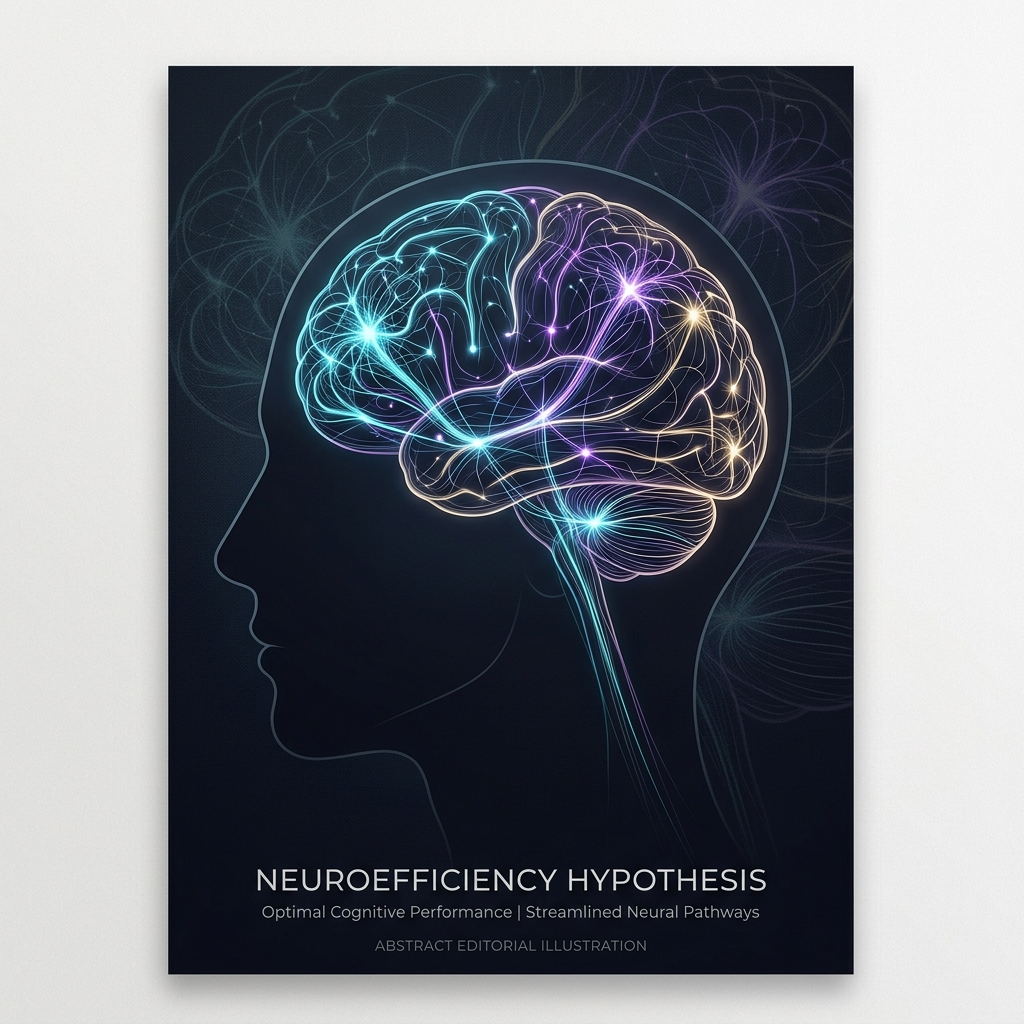
Neuroscience / Scientific Article
The Neuroefficiency Hypothesis: How Genius Brains Optimize Processing
Work smarter, not harder. We analyze the Neuroefficiency Hypothesis—why high-g brains consume LESS glucose and show highly focused neural activation.
Do genius brains burn more energy during complex tests? Counter-intuitively, PET and fMRI scans reveal that highly intelligent brains display lower glucose consumption and more focused activation than average brains. This is the core of the Neuroefficiency Hypothesis.
1. Neubauer's Core Theory: High-g Neural Shortcuts
Formulated by neuroscientists like Aljoscha Neubauer, the hypothesis states that intelligence is not about how hard the brain works, but how efficiently it routes signals. When solving a logical matrix, average brains light up across massive, uncoordinated cortical zones, generating random neural noise. High-IQ brains recruit highly optimized, pre-myelinated neural shortcuts, firing only the precise networks needed.
2. Glucose Metabolism and Focality
Positron Emission Tomography (PET) measures radioactive glucose uptake during task solving. Under moderate mental load, high-g individuals consume far less glucose, showing that their brains run with superior energy efficiency. However, when presented with extremely complex, unprecedented problems, they successfully dial up glucose consumption to maximum levels, demonstrating massive processing endurance.
3. Training and Strategy Optimization
Neuroefficiency can be developed. As you practice a novel skill (like coding or chess), your brain initially shows wide, uncoordinated neural firing. Over weeks of deliberate practice, neuroplasticity prunes away redundant synaptic paths, creating highly focused "efficiency maps."
Cognitive Science Q&A (FAQs)
Q.Does neuroefficiency apply to physical skills?
Yes. Professional athletes' motor cortices show extremely focused, low-energy activation compared to novices, reflecting optimized motor paths.
Q.How does brain myelination affect efficiency?
Myelin acts as insulation for axons. Thicker myelin speeds up electrical signal transmission and prevents signal leakage, directly driving neuroefficiency.
Academic References (Citations)
- Neubauer, A. C., & Fink, A. (2009). Intelligence and neural efficiency. Neuroscience & Biobehavioral Reviews, 33(7), 1016-1023.
- Haier, R. J., et al. (1988). Cortical glucose metabolic rate correlates of abstract reasoning and attention. Brain Research, 447(2), 203-207.
Cognitive Diagnostic Engine
Ready to measure your cognitive balance scientifically?
IQ Lab evaluates your skills across 5 core cognitive domains from a randomized 300-question pool, generating high-precision profiles and personal diplomas completely free.