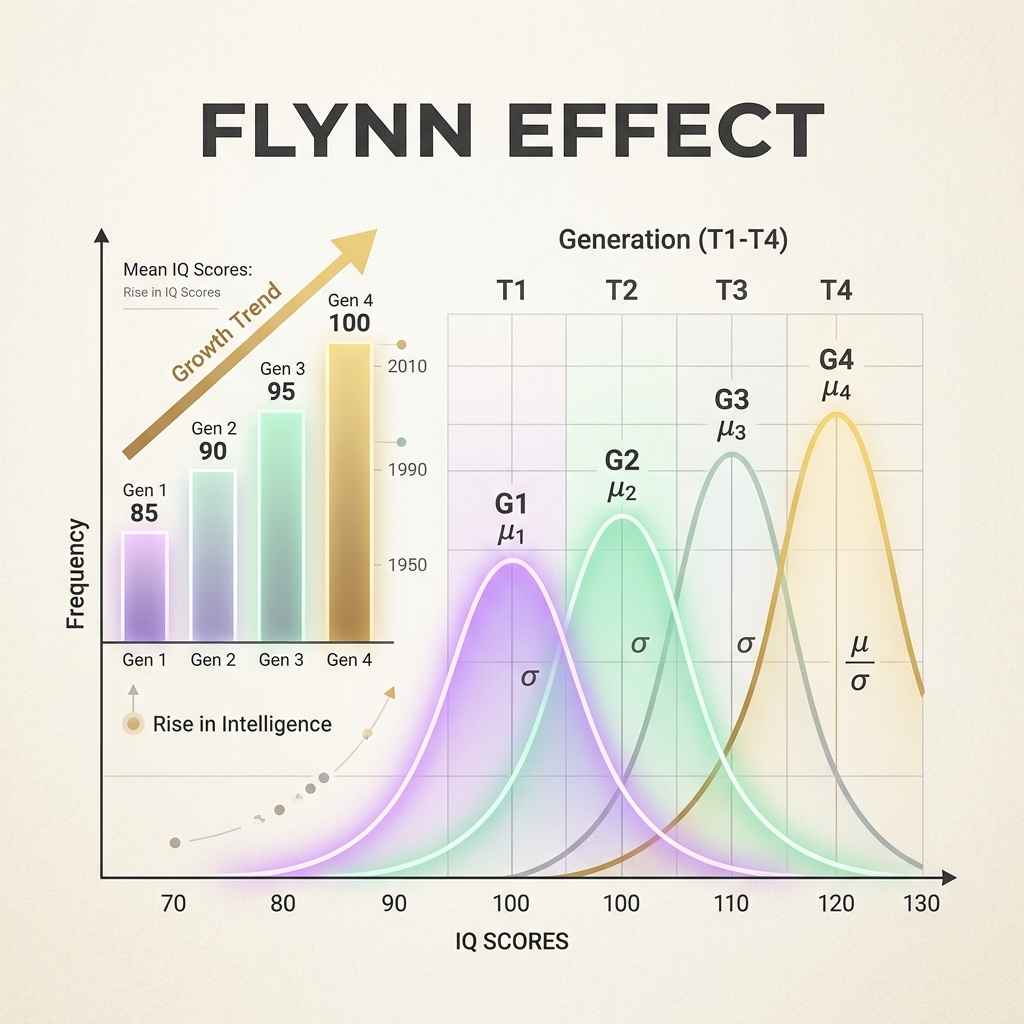
The Flynn Effect refers to the continuous rise in standardized average IQ scores across the global population over generations. Throughout the 20th century, scores have risen by approximately 3 points per decade (9 points per generation), a trend discovered and popularized by political scientist James Flynn.
1. James Flynn's Discovery: Historical Context
Because IQ tests are standardized relative metrics, the average score is always calibrated to "100" based on contemporaneous samples. Flynn realized that if you give historical test standards (e.g., from 30 years ago) to modern generations, they perform remarkably well, scoring an average of nearly 110. Conversely, projecting modern norms back to 100 years ago yields average scores under 70—the clinical cutoff for developmental intellectual delays.
Obviously, our great-grandparents were not intellectually disabled; they successfully operated complex agricultural and commercial systems. The conclusion is that humanity did not undergo rapid genetic evolution; rather, the definition of intelligence and the "lenses" through which we view the world changed.
2. Three Environmental Drivers of the Flynn Effect
- "Scientific Spectacles" (Abstract Thinking): Modern school systems train us to categorize and abstract (e.g., grouping dog and rabbit as "mammals" rather than concrete associations like "dogs hunt rabbits"). Modern minds are equipped with automatic mental tools to process abstract symbols.
- Nutrition and Disease Control: Improved childhood nutrition and reduced infectious disease risks optimized early brain development (myelination), raising the biological ceiling of cognitive infrastructure globally.
- Technological Complexity: Constant interaction with fast visual media, graphical user interfaces, and complex games naturally exercises non-verbal spatial and fluid reasoning daily.
3. Modern Shift: The "Negative Flynn Effect"
In the 21st century, psychometrists began observing a reversal—the Negative Flynn Effect. In highly developed nations like Norway, Denmark, and the UK, average IQ scores of cohorts born after 2000 have begun declining by about 1.5 points per decade.
| Hypothesis | Cognitive Mechanism | Real-world Impact |
|---|---|---|
| 📱 Cognitive Outsourcing | Smartphones, GPS, and AI offload spatial, memorization, and reasoning tasks, reducing the organic load on the prefrontal cortex. | Reduced sustained attention and processing endurance. |
| 📖 Decline in Deep Reading | Consumption of short-form media replaces long-text comprehension, reducing training in complex logical syntax (Crystallized Intelligence). | Weakened text-based logic and analytical depth. |