
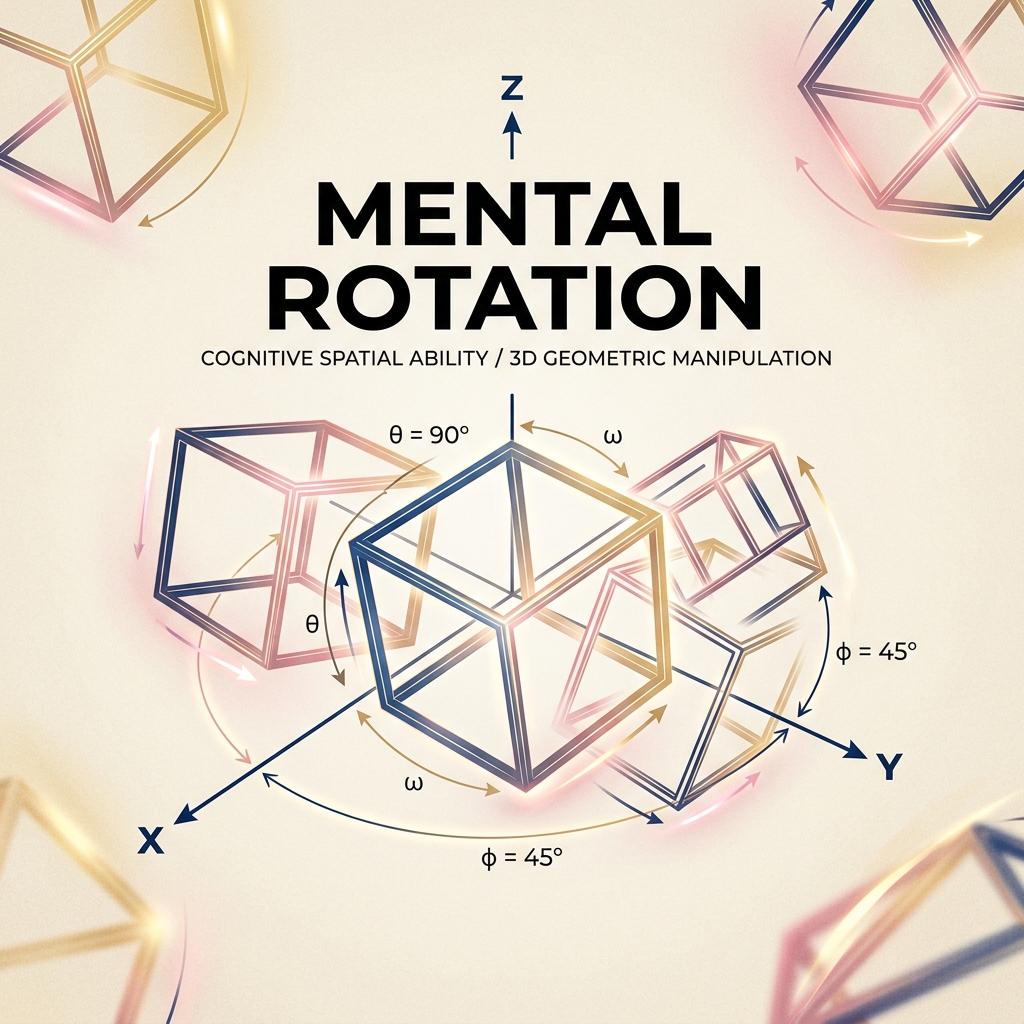
Mental Rotation is the spatial cognitive process of actively rotating mental representations of visual objects (such as 2D or 3D geometric shapes) within the brain's virtual canvas to determine if they match another object. Positioned as the core of Visual Spatial Index (VSI) in psychometrics, it directly connects to "conceptual modeling capacity" in fields like physics, engineering, architecture, and complex system designs.
1. The Shepard & Metzler Experiment: Discovering the Brain's Rotation Speed
The physical existence of mental rotation was scientifically demonstrated in a landmark 1971 study by psychologists Roger Shepard and Jacqueline Metzler. They presented subjects with pairs of 3D block figures and measured reaction times to judge whether they were "rotated identical shapes" or "mirror images."
The data revealed an elegant mathematical law:
- Linear Relationship: The reaction time to correctly identify identical shapes increased strictly linearly with the angular difference between the two shapes.
- Rotational Velocity of 60 Degrees/Sec: The brain literally rotates mental images at a constant speed of approximately 50 to 60 degrees per second, mimicking physical law.
2. Neurobiological Basis: Activation of the Parietal Lobe
fMRI scans during mental rotation show strong activation in the Posterior Parietal Cortex, especially the Superior Parietal Lobule (SPL) and the Intraparietal Sulcus (IPS). The parietal lobe acts as the brain's "3D graphics card," processing sensory-visual inputs to map where objects are in space. Mental rotation is a heavy processing task where the frontal cortex sends a "rotate" command, causing the parietal networks to actively render and update visual images.
3. Strong Correlation with STEM Aptitude
Spatial psychology research shows that Mental Rotation Test (MRT) scores are highly predictive of exceptional success in STEM (Science, Technology, Engineering, Mathematics) domains.
| Field | Application of Mental Rotation | Required Resolution |
|---|---|---|
| 💻 Software Engineering | Mapping multi-dimensional arrays, memory pointers, and multi-inheritance class topologies mentally. | High (Structure Mapping) |
| 🩺 Surgery & Anatomy | Projecting patient anatomy behind flat 2D screens during laparoscopy. | Extremely High (Millisecond dynamic updates) |
| 📐 Mechanical CAD Design | Instantly converting 2D blueprint lines into mental 3D holographic structures. | Extremely High (Precision rendering) |