
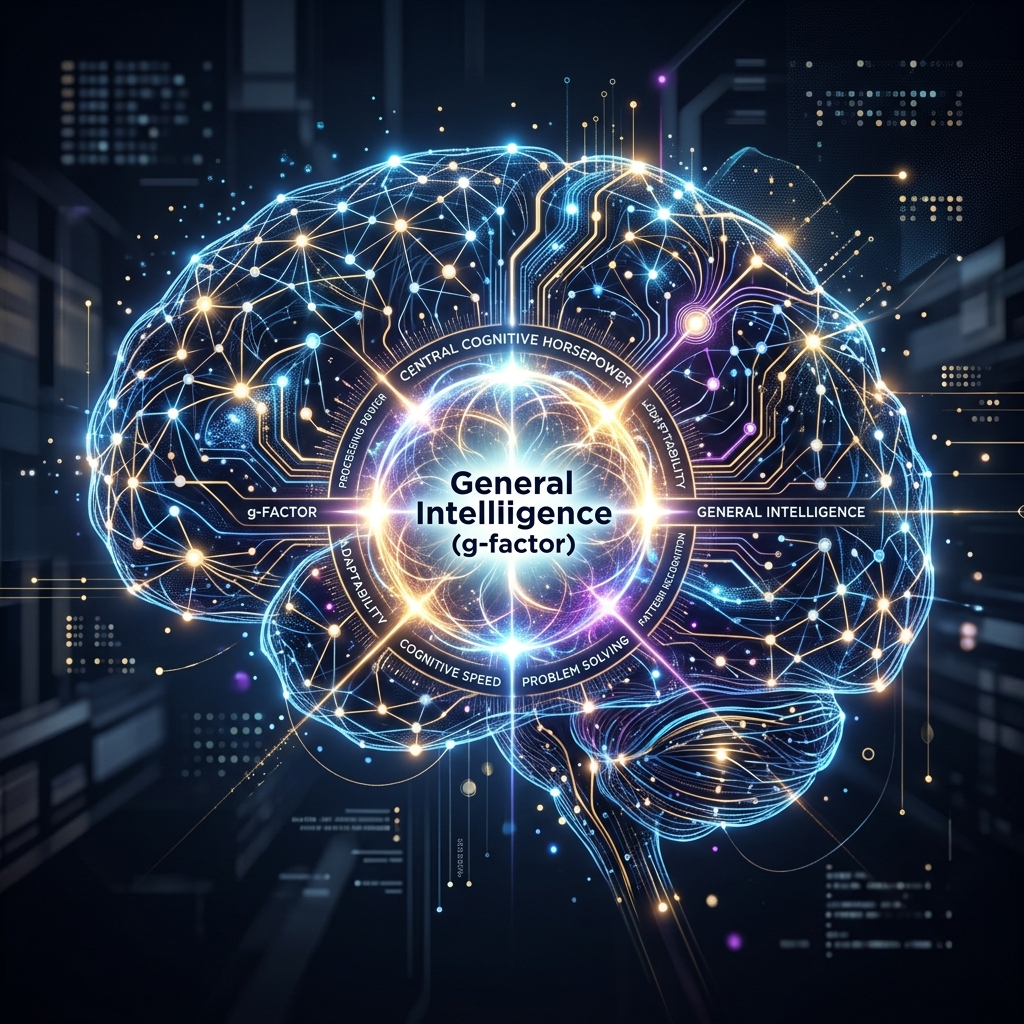
General Intelligence, commonly known as the g-factor, is the foundational mathematical construct in cognitive psychology. Discovered by Charles Spearman in 1904, it represents the shared mental energy that drives performance across all diverse intellectual tasks, from math to reading comprehension.
1. Spearman's Discovery: Positive Manifold
Spearman realized that if a student scored high in geometry, they also tended to score high in foreign language tests. He mathematically termed this global correlation the "Positive Manifold" and developed Factor Analysis to isolate the underlying factor "g" which typically accounts for 40-50% of the variance in all cognitive batteries.
2. Biological Basis: Neural Efficiency and Brain Plasticity
The biological reality of g is explained by the Neural Efficiency Hypothesis. High-g brains show lower glucose consumption during easy tasks, meaning they solve problems using highly optimized neural paths, saving energy. Furthermore, raw cortical thickness, white matter structural integrity, and synaptic pruning efficiency underwrite high-g scores.
3. Modern Consensus: Hierarchical Models
Modern models (like CHC theory) place g at the absolute apex (Strata III), branching into broad abilities like Gf, Gc, Gsm (memory) in Strata II, which further branch into narrow skills in Strata I. This framework combines both global and specific models of human capability.