
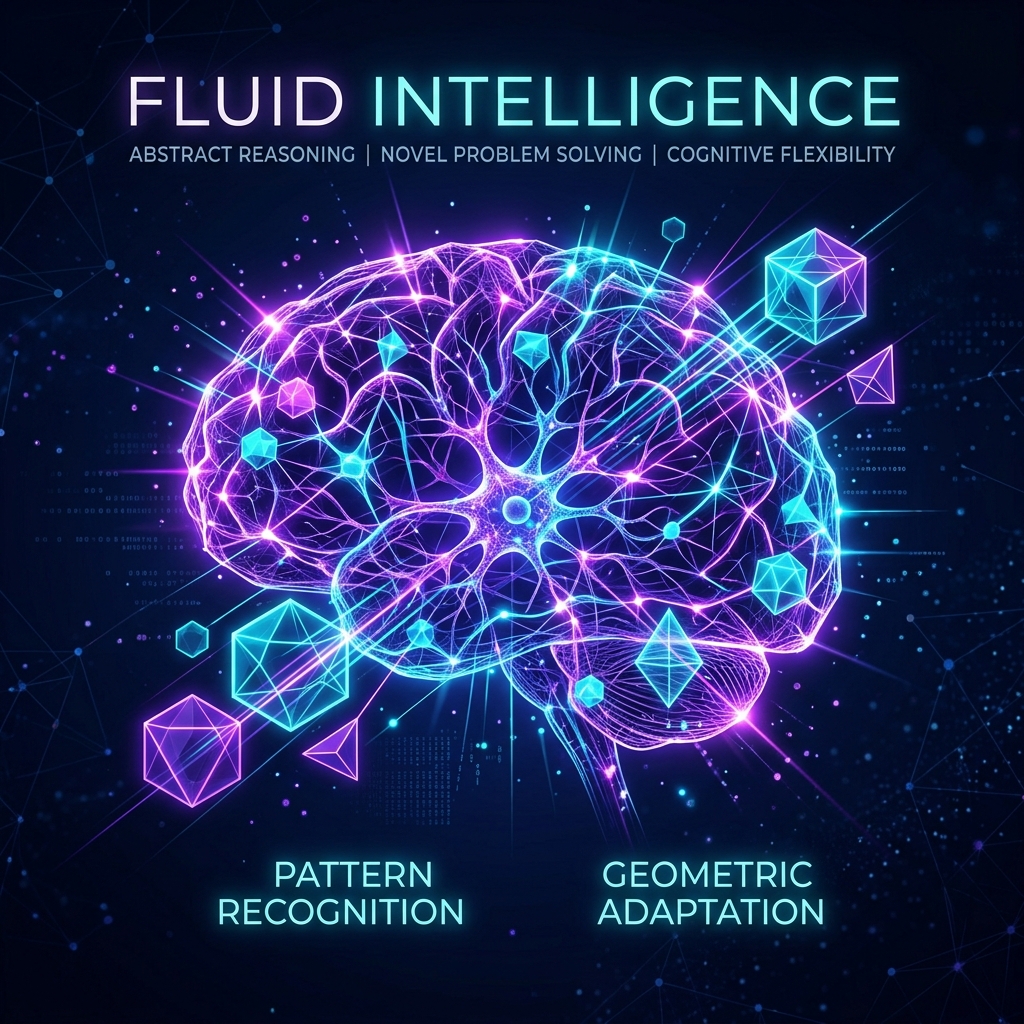
Fluid Intelligence (Gf) represents one of the two core pillars of intelligence proposed by Raymond Cattell. It refers to the biological capacity to solve novel, complex, and abstract reasoning problems that do not rely on previous training, education, or cultural familiarity. It represents raw "analytical engine speed."
1. The Two-Factor Theory: Fluid (Gf) vs. Crystallized (Gc)
Cattell split general intelligence (g) into Fluid Intelligence (Gf) (nature) and Crystallized Intelligence (Gc) (nurture). While Gf is culture-fair and relies on abstract pattern-matching (e.g., Raven's Matrices, numeric progressions), Gc relies on database recall, vocabulary, and learned heuristic expertise.
2. Neural Infrastructure: Prefrontal-Parietal Coordination
Neuroscience maps Gf primarily to the Frontoparietal Network linking the prefrontal cortex and parietal lobe. This network dictates the processing bandwidth of working memory (r > 0.7 correlation with Gf). A larger mental desk lets the brain hold more abstract variables simultaneously to discover logical rules.
3. Developmental Decline: Peak and Age Changes
Gf peaks in late adolescence/early 20s as biological myelination reaches maximum efficiency. Thereafter, it slowly declines due to normal biological aging of neuronal fibers. However, this is heavily compensated for by the lifelong growth of Crystallized Intelligence (Gc).